ARXEON Dynamics
An open-source 10.5 GHz phased-array radar and the operator GUI that commands it — electronic beam steering, MTI and CFAR target tracking, and live FPGA signal processing. Built as the foundation for the first defense and intelligence technology company in Iraq.
The Python command GUI, in action
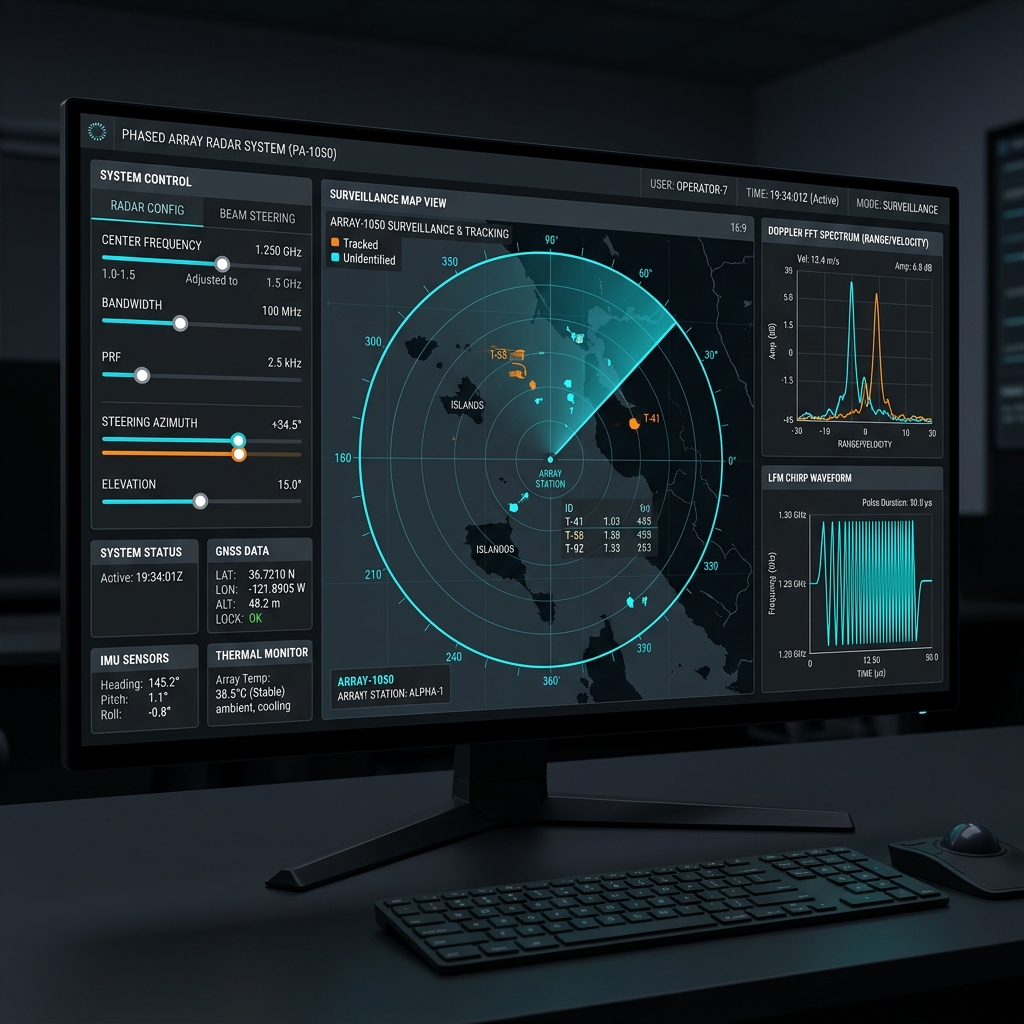
*Note: some of these visual representations are concept-generated and may differ slightly from the active production environment.
The System
AERIS-10 is a fully open-source, modular, and hackable 10.5 GHz phased-array radar. The GUI is the layer that bridges complex RF hardware and the operator — turning raw analog echoes, processed through the hardware stack, into real-time visualization, tracking, and system control.
Georeferenced targets on a live map.
Fuses GPS (UM982) and IMU (GY-85) data to correct target coordinates for platform pitch and roll, then plots multiple tracks on an interactive map using moving-target-indication (MTI) and constant-false-alarm-rate (CFAR) detection.
Steer the array without moving it.
Interactive controls drive the STM32 and FPGA to perform electronic beam steering of ±45° in both elevation and azimuth via ADAR1000 phase shifters, with mechanical scanning available through stepper motors.
See the raw physics in real time.
Live plots for Doppler FFT processing and LFM chirp waveforms, rendered straight from the FPGA’s I/Q baseband down-conversion and pulse-compression stages — the actual signal, not a simulation.
Keep the array inside its envelope.
Continuous readings from the array’s temperature sensors trigger the cooling subsystem when needed, alongside positional telemetry — so the operator always knows the physical state of the hardware.
From a chirp to a track, in one pass.
The software control layer integrates directly with the physical array, visualizing raw analog signals after they move through the hardware stack — amplified, phase-shifted, digitized, and compressed.
Pulse Generation
The GUI sets parameters — center frequency, chirp duration — and sends them to the STM32, which commands the DAC to generate the PLFM chirps.
Transmission & Reception
Chirps are amplified and steered by the phased array. Echoes returning from targets are captured, phase-shifted, and mixed down to an intermediate frequency.
Heavy Lifting on the FPGA
The FPGA processes the raw ADC data, performing the computationally expensive work — Forward FFT, pulse compression, and Doppler processing — to separate stationary clutter from moving targets.
Visualization
Processed detections — range, velocity, angle — are streamed over high-speed USB to the Python application, where they are mapped and plotted instantly for the operator.
The first defense and intelligence technology company in Iraq.
AERIS-10 is the opening move — sovereign, open-source radar built from commodity parts and a Python control plane, proving that serious sensing and signal-processing capability can be designed and owned locally.